
Fruit flies in the winery: More than a nuisance
Rebecca Rainbow
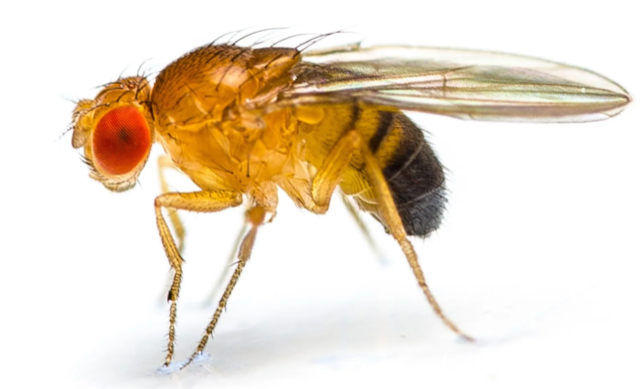
It’s inevitable, fruit arrives in August and by September, your kitchen, lab and cellar are filled with swarms of tiny flies. Winemakers have accepted fruit flies (Drosophila melanogaster) as part of the process, but are they simply a winery nuisance or a true nemesis? With fermenting juices, wet pomace, and sticky spills readily available, the winery offers both food and breeding sites—it’s no wonder they take up residence fast. Understanding what attracts these pests, and where the next generation is developing, may help control their populations and protect your wine more effectively.
Fruit flies are a general annoyance while you are trying to work, but the real problem is their ability to transport microorganisms1–4. Fruit flies act as vectors of yeasts and bacteria, specifically acetic acid bacteria (AAB), which cause the accumulation of acetic acid and high volatile acidity (VA) in wine2–4.
The problem can begin before grapes reach the cellar. Damaged berries provide breeding sites for flies and favorable conditions for spoilage microorganisms, allowing acetic acid to accumulate in the vineyard4–6. Rain-related splitting, rot, and damage from birds or other wildlife can increase this risk5. Incoming lots with sour rot don’t just cause concern for that fermentation, once the flies are in the winery, those spoilage microbes can be spread to your healthy juice and over vintage wines7,8.
Despite their name, fruit flies respond to more than fruit. Drosophilid flies are specifically attracted to ethanol and the esters produced by fermenting yeast1,9. These volatiles trigger flies to lay eggs, while the fermenting biomass provides developing larvae with essential amino acids and vitamins1,3,7. For a winery, the practical implication is straightforward: a small amount of fermenting residue can be an attractive breeding site. Wet grape debris, a forgotten juice sample, or residue beneath equipment can keep supporting flies even after the obvious spills are gone10.
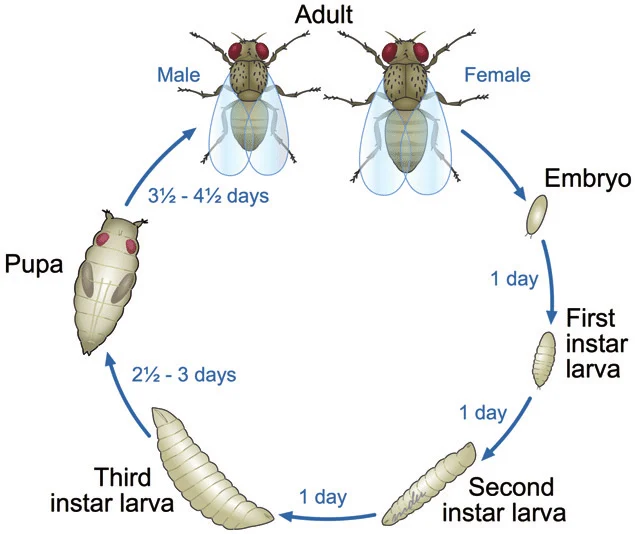
Unfortunately, trapping adults is not enough to control fruit flies and protect fermentations. By the time flies are swarming, the next generation is already developing nearby. Fruit flies develop through four life stages (Figure 1)
- Eggs are laid on moist, fermenting material. Each adult female can lay 700-800 eggs in her 20-30 day life span6!
- Larvae feed on that material until their third instar, when they move to drier areas to pupate.
- Physically protected by hardened skin (the puparium), pupae transform into adults over the course of 4-5 days5–7.
Under favorable environmental conditions (warm, moist, abundant food), the entire life cycle can take approximately 8-10 days6, though in the cool conditions of the cellar, this can take several weeks. While traps capture the adults you see, eggs, larvae, and pupae may already be developing nearby.
Figure 1: The lifecycle of Drosophila Melanogaster11
The most effective way to reduce the fruit fly population is to eliminate fruit and juice residues that act as breeding sites. Moisture and organic material are plentiful during harvest, but prompt cleanup and frequent waste removal can keep them from supporting successive generations4,10. For best practice, remove grape debris and spills promptly, empty and clean waste containers, and rinse sampling equipment after use. If fly activity remains high, look for overlooked sources beneath equipment, inside discarded containers, around drains, and on damp cleaning tools10. Clean accessible drain surfaces to remove organic buildup and allow mops and towels to dry between uses10. Don’t miss nearby crevices and drier surfaces where larvae may have moved to pupate10.
Baited traps can be used alongside cleaning steps to reduce adults and track activity. Commercial fruit-fly traps or contained apple-cider-vinegar traps can help4,6. Refresh traps regularly and watch for increased catches, which can signal a need to investigate for nearby breeding sites. Trapping supports sanitation, but it cannot compensate for removal of fermenting residues.
Because fermentation is the primary driver of fruit fly activity, yeast starters deserve particular attention7. Acetic acid bacteria introduced into a startup yeast culture can subsequently be transferred to a much larger lot. As a practical precaution, prepare starters with clean, sanitized equipment, protect them from fly access with a lid or towel, and minimize unnecessary exposure during handling.
For native starters, assess the fruit condition before use. A contaminated starter can increase the level of spoilage organisms in the receiving fermentation9. Unexpected off odors should be investigated rather than dismissed as something that will disappear in the tank.
General winery hygiene practices already in use to control acetic acid bacteria also help reduce the spoilage risk posed by fruit flies. Sorting out damaged fruit, establishing fermentation promptly, and limiting oxygen exposure make conditions less favorable for the microorganisms that flies spread, helping protect wine alongside sanitation and fly control4,9,12.
Seeing fruit flies in your cellar does not guarantee spoiled wine. But addressing their breeding sites and protecting vulnerable juice, starters, and stored wine can reduce the risk, especially during a challenging harvest.
References
1. Becher, P. G. et al. Yeast, not fruit volatiles mediate Drosophila melanogaster attraction, oviposition and development. Funct. Ecol. 26, 822–828 (2012).
2. Hall, M. E. P. Sour Rot on Grapes: Understanding the etiology and developing management strategies. (Cornell University, Geneva, New York, 2018).
3. Ioriatti, C. et al. Drosophila suzukii (Diptera: Drosophilidae) Contributes to the Development of Sour Rot in Grape. J Econ Entomol 111, 283–292 (2018).
4. Clark, M., Burkness, E., Horton, D. & Hutchinson, B. Alert: Spotted Wing Drosophila (SWD) in Grapes. University of Minnesota Grape Breeding and Enology https://enology.umn.edu/news/alert-spotted-wing-drosophila-swd-grapes (2016).
5. Loeb, G. Grape Insect and Mite Pests, 2024 Field Season. Cornell Cooperative Extension: Finger Lakes Grape Program https://nygpadmin.cce.cornell.edu/pdf/newsletter_notes/pdf148_pdf.pdf (2024).
6. Varela, L. G. et al. Drosophila Flies. UC Statewide Integrated Pest Management Program https://ipm.ucanr.edu/agriculture/grape/drosophila-flies/#gsc.tab=0 (2015).
7. Quan, A. S. & Eisen, M. B. The ecology of the Drosophila-yeast mutualism in wineries. PLOS ONE 13, e0196440 (2018).
8. Griggs, R. G. et al. A tale of two vineyards: parsing site-specific differences in bacterial and fungal communities of wine grapes from proximal vineyards and their changes during processing in a single winery. Appl. Environ. Microbiol. 91, e00526-25 (2025).
9. UC Davis Viticulture and Enology. Diagnostic Key Tips for Limiting Off-Characters Arising during Wine Maturation and Storage. UC Davis Viticulture and Enology https://wine.ucdavis.edu/industry-info/enology/fermentation-management-guides/key-diagnosing-problem-fermentations/diagnostic-key-tips-limiting-characters-arising-during-wine-maturation-and-storage (2018).
10. Iowa State University Extension and Outreach. Fruit, Vinegar, and Pomace Flies. Iowa State University Extension and Outreach https://yardandgarden.extension.iastate.edu/encyclopedia/fruit-vinegar-and-pomace-flies (2026).
11. Ong, C., Yung, L.-Y. L., Cai, Y., Bay, B.-H. & Baeg, G.-H. Drosophila melanogaster as a model organism to study nanotoxicity. Nanotoxicology 9, 396–403 (2015).
12. Osborne, J. Dealing with damaged fruit in the winery. Oregon State University Extension https://extension.oregonstate.edu/crop-production/wine-grapes/dealing-damaged-fruit-winery (2024).
